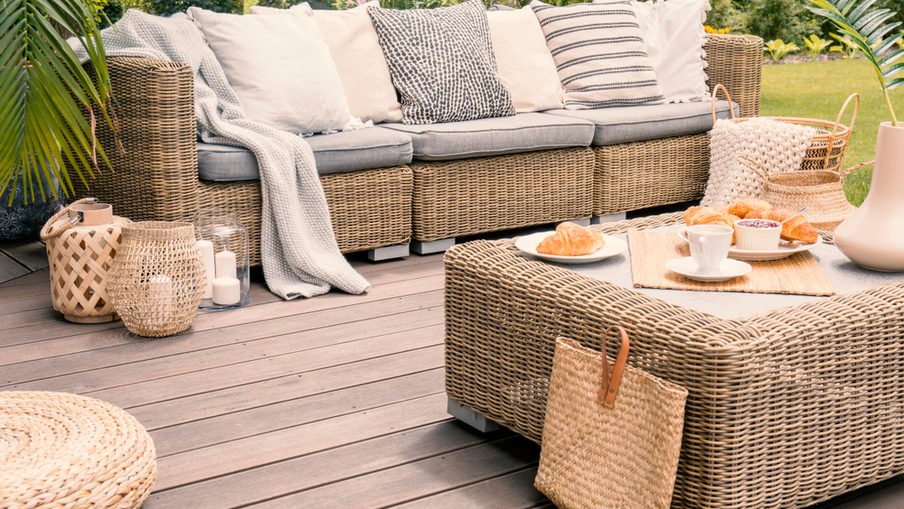
Ideal for year-round socialising and relaxation, decking adds a hugely functional aspect to your property.
For such a high-traffic, high-impact outdoor area, the best timber species must be dense, durable and good looking. Hardwoods like iroko, oak, balau and ipe step up to this job superbly.
Softwoods like Siberian larch and modified types of pine (like Accoya and Thermo-pine) also offer fantastic exterior performance for decks.
Let’s dive into the best decking options in a little more detail.
1. Iroko

A tropical African hardwood, iroko has the well-earned nickname ‘African teak’ which speaks to its natural beauty, durability and strength.
The species’ warm golden browns offer an exotic, premium feel. The timber’s variance in colour becomes less profound after being oiled.
Slow-growing, iroko is exceptionally dense and scratch resistant. The wood also produces its own natural oils. These protect against moisture, fungal damage and rot and make it highly stable.
Iroko represents a timeless, archecturally-led, long-lived choice for any deck.
- Price point: ~£70 per m² (excluding VAT)


2. Oak

Elegant, timeless, high performance: oak has stood is a perennially popular choice for very good reason.
A fairly economical choice, oak offers exceptional value for such a top-performing hardwood.
Its medium-golden brown hues and characterful grain pattern slot seamlessly into any outdoor space.
Oak usually comes in a grooved (fluted) profile. It is also available in longer ‘finger-jointed’ lengths, making it particularly suited to large projects.
European oak is prone to some small movement, so it is important to account for this by including a marginally larger gap between the boards. A typical gap is 5mm – consider increasing this to around 7mm.

This species is also available as Thermo-oak, whereby oak undergoes thermal modification using heat and steam in an oxygen-free environment.
The process enhances the wood’s stability and outdoor durability, as well as imparting a darker brown colour.
- Price point: ~£45-55 per m² (excluding VAT)

3. Balau

A tropical hardwood, balau blends exotic beauty with exceptional outdoor performance.
Strength, stability, durability – this Southeast Asian hardwood leaves no box unticked.
A great choice for a premium deck sharing all the properties of the aforementioned iroko, the difference between the two is balau’s more consistent reddish-brown colour.
Balau’s high levels of water resistance makes it a particularly popular choice for poolside decking. Aside from residential projects, the wood is widely used for marine applications (docks, wharves, jetties) and boatbuilding.
- Price point: ~£65-75 per m² (excluding VAT)
4. Ipe

Hailing from the rainforests of South and Central America, ipe is one of the hardest, most durable woods used in outdoor construction.
Its density gives it outstanding resistance to rot, insects and heavy wear.
Where balau leans reddish-brown, ipe runs deeper and richer. Its dark chocolate-brown mellows to a silvery grey if left unfinished.
Ipe is a long-standing favourite for coastal piers and public walkways. Needless to say, this also makes it a fantastic choice for high-end residential decking.
- Price point: ~£85-100 per m² (excluding VAT)

5. Thermo-pine

Also commonly known as ThermoWood®, Thermo-pine is a high-performance heat-modified softwood.
Starting its life as Scandinavian pine, the treatment alters the wood’s structure to boost its outdoor durability and stability.
With its warm honey-brown colour, sound knots and pronounced grain, this species also has plenty of natural character.
The wood can be further treated with a deck oil to maintain the dark colour, or can be left to weather naturally to a refined silvery-grey.
Thermo-pine is a particularly cost-effective solution.
- Price point: ~£35 per m² (excluding VAT)


6. Siberian larch

Siberian larch’s density defies its status as a softwood.
This slow-growing, cold climate timber packs in a huge amount of strength and scratch resistance.
The species also boasts natural resistance to rot, moisture and fungal attack, suiting it superbly to outdoor use.
The wood’s stunning pale straw-yellow colour and vibrant grain pattern make it a timeless and characterful choice.
It also typically comes in at a lower price point.
Larch is available in longer lengths, similar to European oak.
However, it can be similarly prone to movement, so consider a gap of around 7mm between each board, compared to 5mm for most species.
- Price point: ~£40-50 per m² (excluding VAT)
7. Accoya

Accoya is a specialist modified wood product created by acetylation of Radiata pine softwood.
This patented process alters the wood's cellular structure to make it more durable, stable and rot resistant.
Moisture is the biggest factor affecting outdoor durability. Accoya uses acetic anhydride to increase the wood’s moisture-resistant acetyl groups and reduce water-attracting hydroxyl groups.
It gives the wood Class 1 durability, with the product carrying a 50-year above-ground warranty.
Unlike heat modification, the process maintains pine’s versatile, clean pale yellow to golden-brown colour.
- Price point: ~£85 per m² (excluding VAT)
8. Thermo-ash

Thermally-modified European ash is another heat-treated decking timber.
The modification process darkens the wood's natural colour to a rich, dark and opulent chocolatey-brown tone.
This decking product also has Class 1 durability, with a service life of over 25 years if left untreated.
- Price point: ~£35 per m² (excluding VAT)
What about cheaper decking options?
The woods mentioned above are all specially selected for their beauty and performance. We believe they offer superior cost effectiveness over the long term, giving at least 25 years’ service life.
It is possible to create a solid deck from cheaper options available at home improvement stores, but these are typically made from tanalised (chemically pressure treated) softwoods. They don’t offer the same longevity.
Whilst not cheaper, for a particularly low maintenance solution that sacrifices some of wood’s natural beauty, you might also like to take a look at composite decking.
Ready to start your decking project?
We are a leading UK supplier of quality softwood and hardwood decking.
We work with DIYers, architects, designers and tradespeople on every aspect of their project. If you have any questions, don’t hesitate to get in touch.


