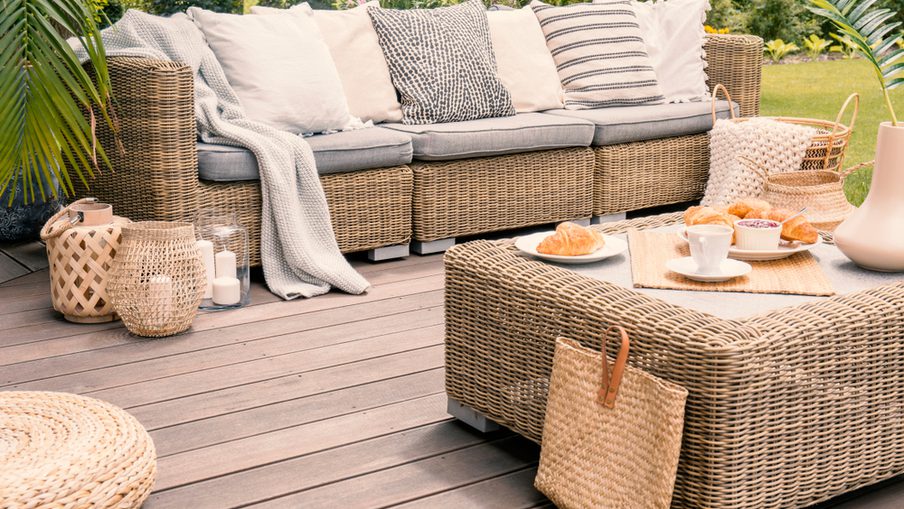
Answers to some of the most common questions around timber decking.
Basics, costs and specification
Essential need-to-knows when planning a timber decking project.
Decking is an outdoor flooring system usually used as a way of extending functional space beyond the interior of a building. It can be raised or at ground level.
Structurally, it is composed of boards that are precision-machined to a consistent shape and size, which are then laid over a supporting frame to create a level surface.
In residential properties, decking is commonly found in gardens and patios. In commercial environments, it’s often used for high-traffic walkways and leisure spaces.
The most popular material to create decking is timber, due to its natural durability, strength, sustainability and aesthetic appeal. Low-maintenance composite solutions are also widespread.
The best woods for decking are those that combine natural durability and stability outdoors with strength and scratch resistance.
Some of the most commercially-popular, high-quality options include iroko, oak, Thermo-pine, Thermo-ash and Accoya®.
Composite decking – which is a blend of wood and plastic – is also a fairly popular low-maintenance solution.
Read more: Best wood for decking: design, trends, costs and tips
It depends on the standard of the decking product you choose and whether you need to hire a professional for installation.
Including only the timber boards:
- Premium hardwood decking, such as iroko or oak: around £60 per m² + VAT
- Mid-range quality softwood decking, such as Thermo-pine: around £35 per m² + VAT
- Lower-end tanalised softwood decking, such as those at DIY stores: around £25 per m² + VAT
- Composite decking: around £40 per m² + VAT
Taking a typical decking area of around 20m², boards in a higher-end species like iroko will cost around £1100 + VAT. In a quality mid-range species like Thermo-Nordic pine, it'll be £640 + VAT. At the lower end, a tanalised softwood deck may run you as little as £300.
Note that the costs above don’t factor in installation costs, which can run £250–£350 per day. For a two-day job, be prepared to pay in the £600 region.
So, for a rough cost estimate that includes both timber boards and installation costs:
- Premium hardwood decking: around £120 per m²
- Mid-range quality softwood decking: around £80 per m²
- Lower-end tanalised softwood decking: around £60 per m²
- Composite decking: around £100 per m²
Given these labour and installation costs will be roughly similar regardless of the quality of timber you choose, we’d recommend a high-end, mid-range or composite option to maximise your investment.
Read more: How much does timber decking cost and how much do I need?
Start by measuring the length and width of the proposed area for your decking in metres.
For a rectangular deck, simply multiply these two dimensions together. This will give you the area in m².
If your decking area is non-rectangular, simply break the shape down into smaller, more manageable segments, like squares or triangles, then add them together.
Don’t forget the 10% rule – you should avoid buying the exact amount needed, but instead plan for 10% wastage.
Most decking products are priced per square metre, so once you have your total area (including the 10% buffer), simply multiply it by the cost per m² to estimate your total cost.
Read more: How much does timber decking cost and how much do I need?
It completely depends on personal preference.
If you value the natural beauty and authenticity of timber, then a solid wood deck should be your choice.
If you want a lower-maintenance solution and you’re happy to compromise on wood’s natural features, then composite will be better.
Both timber and composite decks cost a similar amount of money and, if well cared for, have a similar service life before requiring replacement.
To prevent rot and decay, you should choose ‘Use Class 4’ (UC4) wood. This has been specifically treated for ground contact. UC refers to durability and treatment.
Something else to pay attention to is the C-Grade, which refers to structural strength. C16 grade timber is standard for many residential projects, but C24 is preferred for larger projects due to having fewer knots and superior strength. C24 is also ideal if you want to minimise the number of support posts by using longer spans.
In the UK, these joists are widely available from specialist timber merchants. Be sure to check the labels carefully – at home improvement stores, many products are UC3 (above ground use only). If you cut the timber during installation, be sure to apply a brush-on preservative to the end grain.
Naturally-durable species such as iroko, oak or larch can also be used for decking frames, though they can be more expensive.
The physical dimensions (width and depth) will depend on the specific length of your deck. For most residential projects, standard width is 47mm, whilst the depth ranges from 100mm to 200mm depending on the span between supports.
Regardless of dimensions, be sure to source UC4 (Use Class 4) timber for the frame. This is specifically treated for ground contact. Pay attention to C-Grade, too – this refers to strength. C16 is standard, but C24 allows for longer spans with less timber.
Yes, you can. C16 is commonly used for the structural subframe of a deck, especially for residential projects. C24 might be preferred in some instances, however, due to its superior strength, straighter grain and fewer knots. It allows for longer spans.
It’s important to make sure the wood is at least UC4 (Use Class 4), meaning it has been treated for ground contact outdoor use. UC3 can be used, but UC4 is recommended for the entire subframe to maximise longevity.
The decking boards themselves should be a specific decking grade timber, such as iroko, oak, Thermo-pine, Thermo-ash or Accoya®.
Installation and maintenance
Putting your deck together and maximising its service life.
Firstly, the area should be cleared and a weed membrane topped with gravel added. You can also use concrete pads or adjustable pedestals to support the structure.
The outer rim (or 'ring') beam should be constructed using UC4 C24 joists to ensure the frame can withstand loads. UC refers to durability and C-Grade refers to strength.
The inner joists should be stalled at consistent intervals, typically with 400mm centres ('centres' refers to the distance from middle of one structural member to the middle of the next). These should be secured with screws or joist hangers.
Ensure the frame has a very slight slope away from the building for water run off, and apply a brush-on end-grain preservative for any cut surfaces to prevent rot.
Once the structural frame is constructed using UC4 timber, lay your decking boards perpendicular to these joists.
Leave a 5-8mm gap between each board to allow for water drainage and natural wood expansion due to moisture. These boards should be fixed using quality stainless steel screws.
To minimise the risk of warping, two screws should be driven into each joist intersection.
Once installed, ensure any cut ends are treated with a brush-on end-grain preservative to prevent decay.
Yes, treatments largely shield the timber from fungi and bacteria. This is because the treatments create a barrier against moisture, which is a breeding ground for these wood-decaying microorganisms.
For maximum longevity, start with a naturally-durable species such as iroko, oak, Thermo-pine, Thermo-ash or Accoya®.
These quality woods are naturally insect resistant due to inherent substances they contain, and a quality treatment will enhance these protective properties.
Installing anti-slip strips is the most effective solution – these have a gritted surface to promote traction underfoot. Anti-slip tape or rubber mats can also work.
It’s important to make sure the deck is clean, too. Timber can trap algae, moss, fungi and other mildew, creating a slippery biofilm.
Ensuring your decking is cleaned and swept regularly will prevent this slippery buildup from taking hold.
Applying a quality wood stain can also make a deck less prone to slippiness. Stains will seal the deck, helping to prevent regrowth of slippy mildew and algae.
Read more: How to stop timber decking being slippery in winter: 9 solutions
Start by sweeping away obvious debris and then apply a deck cleaner. There are many great options available at home improvement stores.
You can also create your own cleaning solution using a small amount of dish washing soap with warm water.
Let the solution sit for 10-20 minutes (or however long the product instructions recommend) and then lightly scrub with a stiff brush.
Finally, rinse the deck with a garden hose or low-pressure washer and allow it to completely dry. In winter, this can take a lot longer than anticipated.
Read more:
The first step is to prepare the deck for treatment.
If your decking is old, be sure to check for any damage, remove old finishes using a wood stripper and then sand the deck.
If your decking is fairly new or in good condition, sweep and clean it with a mild decking cleaning solution.
Once fully dry, the deck is ready. You then need to choose a product to apply. A high-quality, penetrating wood stain or sealant will give the best results.
There are a number of options depending on your desired look and level of protection:
- Transparent: If you want to showcase the wood’s natural beauty, a transparent oil (such as Owatrol H4 Wood) will do the trick at protecting your wood from the worst of the outdoor elements.
- Semi-transparent: These provide both aesthetic beauty and great outdoor performance, whilst allowing you to choose a colour tint to help the wood’s grain pattern to pop. Take a look at penetrating, non-film-forming products like Owatrol Aquadecks and Owatrol Textrol.
- Opaque: Solid-colour paints can afford excellent protection and allow you to take full control of the colour of your deck. That said, they can require more frequent top-ups to stay looking their best, and they conceal some of the wood’s natural beauty.
Most products can be applied can be done with a roller or sprayer, but for the most even and consistent results, we’d recommend using a quality brush. As well as a large brush, choose a small brush to get into those spaces between the boards.
When applying the product, be sure to follow the grain — make sure to get into the end gaps, too.
Ideally, treat your decking on a dry, overcast day where the temperature is between 10-25°C. Moisture from rain can lead to coating failure, and baking sunlight can cause the treatment to dry unevenly.
Read more: How to clean, restore, revive and treat wood decking
If high-quality timber is used (such as iroko, oak, Thermo-pine, Thermo-ash and Accoya®), the deck is well constructed and it is well maintained, you can expect over 25 years of service life before replacement might be required.
Didn't find the answer you were looking for? Ask us and we'll get back to you as soon as possible.
Submit your decking question


