Answers to some of the most common questions around timber fencing.
Basics
The essential need-to-knows of timber fencing – styles, types, species.
Fencing is a structure used to mark a boundary, provide security or enhance the exterior of a property. Whilst fencing is traditionally made from timber, some styles can be composite, vinyl or even metal.
Different types of fencing offer various levels of privacy. Solid styles can stand up to 6 feet tall and provide maximum privacy, whilst semi-solid and slatted styles offer a middle ground with airflow and natural light. Picket fencing is typically just a few feet tall and found in front gardens.
Two of the most popular solid fencing styles in the UK are closeboard and overlap.
- Closeboard – One of the most common types of fencing for residential properties, sometimes known as featherboard or featheredge. Vertical boards are tapered and overlap, creating a strong continuous run.
- Overlap – another similar, widely-popular solid style, where horizontal boards are overlapping one another. Some boards can have a waney edge for a rustic look. It offers very similar levels of privacy and boundary marking.
Closeboard and overlap are often sold as pre-made panels, installed with posts made of wood or concrete. Where concrete posts are used, a gravel board is often installed at the base to protect the panel from ground moisture.
Semi-solid and open types of fencing include:
- Hit-and-miss – a semi-solid type manufactured with boards fixed alternatively on the front and back of a batten. As well as being a more decorative style, hit-and-miss is ideal for windy areas by allowing wind to pass through (reducing the strain on posts).
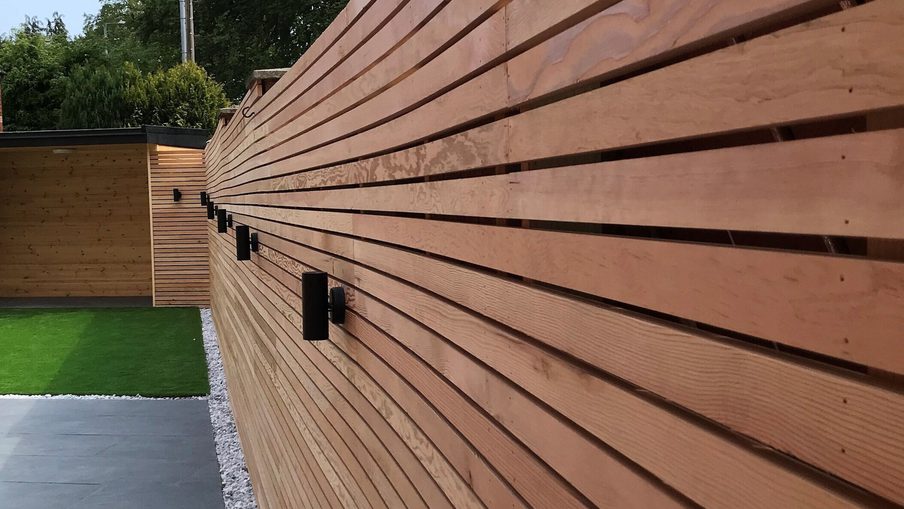
- Slatted – also known as Venetian fencing. An architecturally-led style, slats are fixed with 10mm gaps to provide clean, flowing lines and allow air flow. The slats can vary in width, alternating the amount of privacy.
- Picket – a traditional, open-spaced design typically lower in height. Picket fencing offers little-to-no security, but offers a timeless, decorative boundary-marking solution, popular for front gardens in particular.
Good fencing timbers need to be naturally durable and dimensionally stable outdoors.
For the panels, high-performance premium solutions include western red cedar, Siberian larch, Thermo-ayous and Thermo-pine. These species have natural resistance to decay and an aesthetically-pleasing finish.
Pressure-treated (or tanalised) softwoods, such as spruce and pine, are also popular as a cost-effective solution. They are widely available in DIY and home improvement stores across the UK.
For the posts, pressure-treated woods are essential. They should be UC4 (Use Class 4) standards, meaning they can withstand permanent soil contact and are specifically designed to protect against rot.
Read more:
Machined from timber, fence slats are used to create a semi-solid style of fencing, often known as slatted, contemporary or Venetian fencing.
Common dimensions for these slats include 18 x 45mm, 18 x 68 mm and 18 x 70mm. Lengths available start at 1.85m and can range up to up to 5 metres. They are intended to be fixed to a pressure-treated post or batten, typically with 10mm gaps between slats to achieve a desired look.
The structure provides moderate privacy and clean, flowing lines for an architecturally-led fencing solution. Choosing a wider slat offers increased privacy.
The gaps between the slats also make this style resistant to wind, a common issue with solid or closed styles like closeboard and overlap.
Popular dimensions for fencing slats are 18 x 45 mm, 18 x 68 mm and 18 x 70 mm.
The narrower width (45mm), gives a more airy feel to the fence. Because it requires less timber per slat, it often results in a slightly lower cost per linear metre.
The wider boards (68mm and 70mm) provide greater coverage and privacy, but due to the higher volume of timber, can come at a marginally higher price point.
Lengths available start at 1.85m and can range up to up to 5m, depending on the timber species and stock levels.
Costs and specification
The finer details of planning a timber fencing project.
Fencing is typically priced by linear metre, which includes panels and posts. Costs can vary tremendously depending on the type of wood used and whether installation is required.
Budget softwoods
An standard entry-level solution with wooden posts and pressure-treated softwood panels can cost between £50-75 per metre. This means for a standard 15-metre garden, materials costs would range from £750-£1,125.
With concrete posts and gravel boards, expect to pay an extra £20-30 per metre.
Slatted fencing
When it comes to slatted fencing, costs vary based on the timber chosen and the height of the fence.
For a 6ft high fence, basic softwood slats start at around £50 per metre, but ranging up to £100 per metre for quality planed species like western red cedar, Siberian larch, iroko and Thermo-ayous.
In western red cedar 18 x 45mm slats, costs are around £110 per metre (including VAT) for a 6ft high stack (the 45mm slat and 10mm gap gives 55mm total per row, meaning 33 slats required to achieve a height of 6ft).
Installation and labour
If professional installation is required, hiring a fencing contractor can cost in the region of £250-£500 per day, depending on location and size of team. A straightforward garden fence can usually be completed in 1-2 days.
Removal costs
If an existing fence needs to be removed, factor in additional costs for labour and waste disposal. Many contractors will charge around £20-30 per metre for removal and ‘muck away’ services, covering skip hire and environmental disposal fees.
Total
Overall, all in (materials plus professional installation), costs for a typical 15-metre garden boundary will usually fall between £1,250 and £4,000. It depends on materials chosen, fence style and the existing site conditions.
If you were to clear the site yourself, choose the budget-friendly products and install the fence as a DIY project, costs could realistically start from the £900 region. This budgets for some ‘hidden extras’ like post mix concrete, fixings, tools and delivery fees.
A budget 6ft x 6ft fence panel in the traditional overlap style costs in the region of £30-£40. Closeboard styles typically command a slight premium, with budget-friendly examples in this style in the £50-£60 region. Both of these types will be made from pressure-treated tanalised softwood.
High-end, professionally-finished fence panels can cost much more, especially if a naturally-durable species like western red cedar, iroko or Siberian larch is used.
These types of woods are more commonly used as part of a slatted fencing scheme, rather than panels.
It depends which species you choose, the width of slat and how high you build your slatted fence.
If you want a 1.8m (6ft) fence with western red cedar 18 x 45mm slats, costs are £110 per metre (inclusive of VAT).
(45mm slat + 10mm gap = 55mm total per row, meaning 33 slats are required to achieve the full height of 1.8m.)
If you simply want decorative screening at a height of 1.2m, only 22 slats would be required. Here, the cost per metre in the same product is £73 including VAT.
In a more cost-effective species like Thermo-pine, a 6ft slatted fence will cost £60 per metre, whilst a 1.2m slatted fence would cost £40 per metre.
Choosing a wider slat, for example with a 70mm width instead of 45mm, will cost more as there is more coverage.
Prices are correct as of the time of writing, March 2026.
For a 6ft (1.8m) fence, 8ft (2.4m) posts are usually required. These currently cost around £35.
A concrete base panel (or ‘gravel board’), which sits beneath the fence panel to protect the wood from moisture, costs around £25 (15cm height) and £45 (30cm height).
Measure the boundary you’re wishing to fence with a long tape measure or measuring wheel. This will give you a figure for total linear metres required.
Make sure to order for 5-10% extra materials due to cutting, mistakes or odd angles. Also account for gates, which will require different posts and materials.
Then, you can multiply the metres required by the cost per linear metre for the fencing product you require.
It depends how tall you want the fence, the width of the slats and the gap between the slats. For a 1.8m (6ft) fence in a slat with a 45mm width and a standard 10mm gap, 33 slats will be required. 45mm + 10mm = 55mm.
For a 1.2m tall decorative fence, 22 slats in a 45mm width will be needed to reach the required height.
Common dimensions for fencing slats include 18 x 45mm, 18 x 68 mm and 18 x 70mm.
Lengths available start at 1.85m and can range up to up to 5 metres depending on species chosen and availability.
Slats are typically fixed with a 10mm gap.
There’s no hard-and-fast legal rule on who owns the fence. The only way to find out is to check the property title plan. A single T on your side means you own the fence, whilst a ‘H’ (two T’s) means the fence is shared with the neighbour.
You can obtain a copy of your title deeds from HM Land Registry.
In the UK, the maximum height for a fence without requiring planning permission is 2 metres from ground level (just over 6 feet 6 inches).
If the fence is next to a highway used by vehicles or a footpath of such a highway, the maximum height is 1 metre (just over 3 feet 3 inches).
If you want to build a fence that’s over these height limits, then you will usually need planning permission from your local planning authority (LPA). Usually, this is the planning department of your local council.
Similarly, if the fence is part of (or borders) a listed building, you may need planning permission.
Read more: Garden fence height in UK: do I need planning permission?
Installation and maintenance
Installing your fence and maximising its service life.
Materials required are the timber slats themselves, fixings (stainless steel is recommended to avoid staining) and a spacer (cut to the desired slat gap width).
If you need to install fence posts, then you will need Use Class 4 posts and rapid-setting concrete mix, like Postcrete. A wood preservative is recommended to seal the ends of the timber.
- Install fence posts: If the gap between your posts is over 1.8m (6ft), consider adding some additional posts. This eliminates any risk of the slats bowing over time.
- Measure and mark: Measure the height of your posts and use a string line to ensure the top of the fence will be level.
- Secure slats: Start with the bottom or top row, using a spirit level to check each row is level.
- Spacing between slats: Use a spacer (a piece of wood cut to the desired gap width) to ensure the spacing is consistent.
You might want to finish the wood with a stain. If you’ve chosen a quality timber like cedar, larch or Thermo-ayous, then this isn’t strictly necessary, but doing so can highlight the wood’s grain and natural features.
For a 6 foot (1.8m) fence, an 8 foot (2.4m) post will be required. This allows for 2 feet to be buried in the ground for stability.
The fixings should be long enough to penetrate at least twice the thickness of the slat into the supporting post. For a standard 18mm slat, a 50mm stainless steel nail or screw is ideal.
The hole should be filled until the concrete is within 2-3 inches of the ground surface. This may require 1.5 to 2 20kg bags of pre-mixed concrete, like Postcrete.
If your fence has concrete fence posts, yes, the fence panels will simply slot into the post’s pre-cast U-channel. You may have a concrete base panel (or ‘gravel board’) to stop the wood from being in direct contact with the ground.
If your fence has wooden posts, the panels should ideally be fixed using U-brackets that are fixed to the inside face of each post. Once these U-brackets are in place, the panel can be slotted in and fastened by screwing through the bracket.
To protect against rot and UV bleaching, choose a treatment based on your desired look:
- Colourless: Clear, water-repellent treatments (like Owatrol H4 Wood) will not change the colour of the fence, but allow it to weather naturally to a silvery-grey whilst avoiding any moisture-related structural issues.
- Semi-transparent: Available in a range of tints, these can highlight the wood’s grain whilst offering very good levels of protection. Look for penetrating, non-film forming products like Owatrol Aquadecks or Owatrol Textrol HES.
- Solid-colour: Fence paints that offer robust protection from the elements. These give you a wide colour choice, but they can obscure wood’s natural beauty.
Naturally-durable and stable woods like western red cedar, Siberian larch, iroko and Thermo-ayous contain fungicidal substances and can be left to weather naturally without treatment.
Read more: Quick guide to garden fence treatments, maintenance & care
Apply the product with a natural or synthetic bristle brush using smooth strokes, following the wood’s grain and making sure to get in all corners. The slats should be ideally painted before installation to ensure all four sides and ends are evenly coated.
Read more: Quick guide to garden fence treatments, maintenance & care
If it’s a small crack, waterproof wood glue and a small clamp will usually do the job.
If the damage is significant – such as a rotten or snapped slap – remove the offending piece with a claw hammer or pry bar and replace it with a matching style slat.
Domestic fencing can be taken to a local council recycling centre or tip, where there are dedicated timber and wood waste skips.
You could also hire skip or waste removal (‘muck away’) services. This costs £150 to over £500 depending on the volume of waste.
Don’t burn the treated wood (this can release toxic chemicals) or put it into garden waste bins.
Commercial wood waste should be taken to a licensed waste transfer station.
Didn't find the answer you were looking for? Ask us and we'll get back to you as soon as possible.
Submit your fencing question


