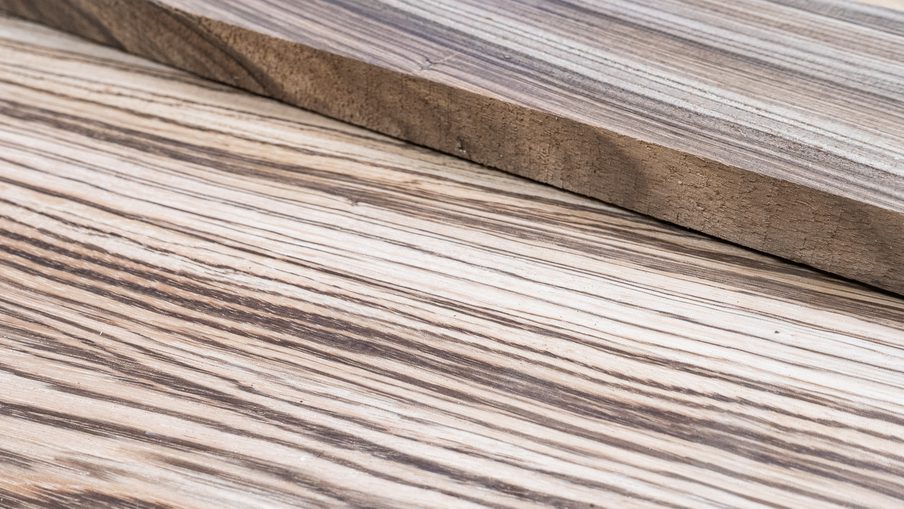
Zebrano (or ‘zebrawood’) is one of Africa’s most iconic and prized hardwoods, so-called due to its light brown-to-cream colour with striking dark brown-to-black stripes.
Scientifically named Microberlinia brazzavillensis, zebrano trees are native to the lowland forests of West Africa. Gabon, Cameroon and the Republic of the Congo all have sizeable populations.
Colour
Zebrano’s heartwood is predominantly a light golden-brown or cream colour, punctuated by narrow dark brown and black stripes.
Depending on how the log is sawn, these zebra-like stripes can be fairly regular or wildly erratic.
Its arresting aesthetic makes the wood an instantly-recognisable, time-honoured favourite for decorative projects.

Grain and texture
Zebrano typically has an interlocked and wavy grain. This gives it a beautiful ribbon figure, but also a medium-coarse texture with large, open pores.

Physical properties
Zebrano is one of the world’s hardest and strongest types of wood, scoring an impressive 7,010 N on the Janka hardness test. It is exceptionally heavy and scratch resistant, clocking in with a dry weight of approximately 805kg/m³.
The wood’s remarkable density and interlocking grain also means it can be fairly challenging to work with. Its high silica content has a blunting effect on tools, but it can fix, glue and finish well, buffing up with a glass-like lustre.
Whilst the wood is not typically applied outdoors, it is naturally durable with high resistance to moisture and insect attack.

Uses
Given its extravagant appearance and fairly high cost, zebrano is best applied strategically and sparingly to make a statement.
It is widely used for high-end furniture making and cabinetry, decorative veneers, architectural wall panels, trims, musical instruments and smaller luxury items (like pens, rings or watches).
Whilst zebrano has exceptional physical and natural properties, it is too expensive for purely functional indoor and outdoor applications.

Cost and prices
Generally speaking, zebrano is not sold in high volumes and it is mainly used decoratively, so prices can be relatively high.
Do not be surprised to pay £120-£230+ per cubic foot of sawn timber.
Boards, blanks and small craft pieces found in hobbyist shops are usually priced individually. These may cost between £10 and £40, with larger and figured blanks at the upper end.
Grain figure and quality of striping can affect pricing, as well as board length and width. Wider boards are more expensive.

Sustainability
As with many African hardwoods, there has been historical concern about overexploitation of zebrano tree populations due to its slow growth cycle.
As long as the wood is purchased from a responsible timber importer who performs the appropriate due diligence and traceability checks, zebrano is sustainable.
The tree was listed as ‘Vulnerable’ according to the IUCN in 1998, but the database notes that this categorisation ‘needs updating’.
Crucially, however, zebrano is not listed in the CITES Appendices, meaning it is perfectly legal to trade internationally with the correct harvesting and export permits.
Ensuring the wood comes from a responsibly-managed forest is key.
Have zebrano’s stripes stolen your heart?
In our hobby hall, we stock sustainably-sourced zebrano sawn boards and blanks, in addition to many other tropical African hardwoods – perfect for a statement woodworking project.
Contact our team today to discuss your requirements, or visit us in-person near Ripon, North Yorkshire and browse the full range. It’s a timber lover’s paradise.
Get in touch


