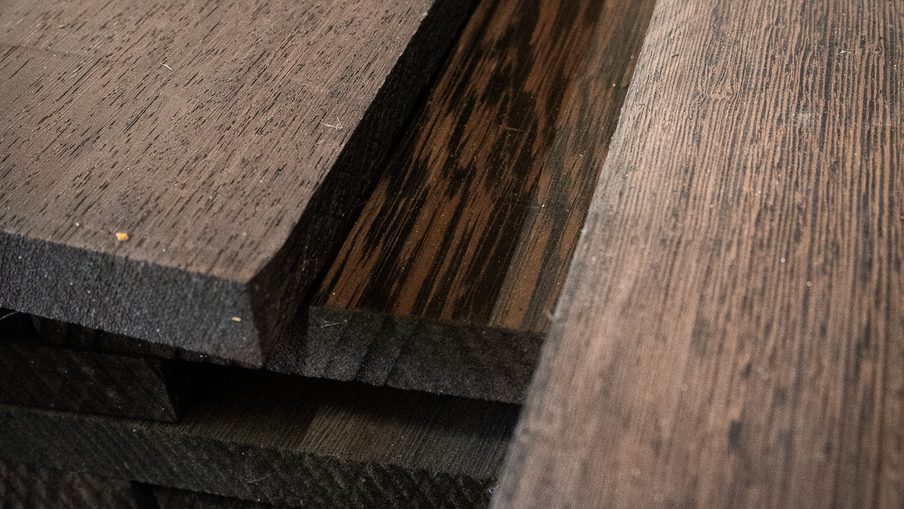
From the creamy chocolatey hues of American black walnut to the almost-black tones of wenge, there’s a range of woods at the darker end of the colour spectrum.
Dark-toned timbers are synonymous with luxury and offer instant design impact in any space.
Naturally eye-catching, they’re perfect for making a statement, and can contrast beautifully with brighter elements or pale woods.
What’s more, trees that produce darker timber are typically slow-growing, making their wood incredibly dense and hard wearing. They’re popular for furniture, flooring and cabinetry.
Some species of dark wood also boast high natural durability, meaning they can even perform well outdoors.
Naturally dark wood types and species
Naturally-dark timbers are fairly uncommon in temperate climates, with many well-known examples being tropical hardwoods.
This is because trees in tropical climates endure higher levels of biological stress from fungi and insect pests. This leads the trees to develop a high extractive content in their heartwood as a defence mechanism.
Some of the most widespread and commercially popular darker woods include American black walnut, wenge, ebony and sapele.
American black walnut

- Colour: Rich chocolate brown to dark purplish-brown
- Grain: Generally straight; medium to coarse texture; occasional curl or crotch figure
- Origins: Eastern US
- Uses: Fine furniture, cabinetry, interior joinery, veneers
- Cost: Medium; widely available, but premium grades command high prices
For a fairly commercially widespread decorative dark wood, look no further than walnut.
Its mix of dark chocolate browns and creams, sometimes with a tinge of purple, offer effortless elegance.
Walnut is a very popular luxury solid wood flooring option. It also works excellently for doors, chairs, tables, drawers and sideboards.

- Colour: Very dark brown to near black, with lighter brown streaking
- Grain: Straight to slightly interlocked; coarse texture with pronounced pores
- Origins: Central and West Africa
- Uses: Furniture, flooring, veneers, interior detailing, turned objects
- Cost: High; availability variable
An incredibly hard-wearing African species, wenge’s almost-black colour with hints of caramel are sure to make a statement.


If this tropical timber takes your fancy, be sure to take a look at our in-depth guide to wenge.
Ebony

- Colour: Jet-black (African ebony); black with dark brown streaks (Macassar ebony)
- Grain: Straight and fine
- Origins: West Africa (African ebony); Sulawesi, Indonesia (Macassar ebony)
- Cost: Very high with limited availability
Two of the most recognised species are African ebony (native to West Africa) and Macassar ebony (native to Indonesia).
African ebony boasts a stunning, uniform jet-black appearance, with almost no visible grain pattern.
Macassar ebony, on the other hand, is renowned for its high-contrast black, dark brown and reddish stripes.
Both woods are under regulation for sustainability and trade legality. For this reason, expect to see only smaller sizes available, rather than large dimensions – but the striking darkness of ebony means it cannot escape mention.
Sapele

- Colour: Dark reddish brown; darkens with age
- Grain: Interlocked; medium texture; pronounced ribbon figure on quarter-sawn surfaces
- Origins: West and Central Africa
- Uses: Furniture, joinery, doors, veneers, musical instruments
- Cost: Medium; good availability
Sapele is prized as a more sustainable, cost-effective alternative to genuine mahogany. Both share the same family, Meliaceae, and a gorgeous deep reddish-brown tone.


For more information on this African beauty, don’t miss our sapele guide.
Utile

- Colour: Medium reddish-brown; darkens with age
- Grain: Straight to shallow interlocked; medium texture
- Origins: West and Central Africa
- Uses: Furniture, joinery, veneers
- Cost: Medium; typically less expensive than sapele
Like sapele, utile often draws much comparison to mahogany resulting from its dark reddish-brown colour that deepens and intensifies with age, coupled with its remarkable physical strength.
Zebrano

- Colour: Golden brown with with dark brown to black striping
- Grain: Strongly interlocked; coarse texture with bold figure
- Origins: West Africa
- Uses: Veneers, furniture, interior panels, small worked pieces
- Cost: Medium-to-high; widely available but usually in smaller sizes and boards
Zebrano (or zebrawood) is another African hardwood sitting towards the darker end of the spectrum.
Its fascinating mix of creams, browns and black streaks make it a highly decorative and characterful darker timber, perhaps best used sparingly as part of a statement piece of furniture. There can be a lot of variation between different pieces.
The species is infamous for its interlocking grain, which can make it difficult to work with, but the results always make it worth the effort.


- Colour: Olive-brown to very dark brown; may appear almost black
- Grain: Fine to medium texture; usually straight
- Origins: Central and South America
- Uses: External decking and cladding
- Cost: High
Also known as Brazilian walnut due to its resemblance to true walnut, ipe offers a rich darker brown colour.
The wood can also show occasional pops of hints of green and yellow, and it ages gracefully when exposed to the elements – even without treatment. Its colour can be darkened further with the application of a quality penetrating stain.
Ipe is one of the densest commercially available timbers. It weighs over 1,000kg/m³ (European oak, for comparison, is around 675kg/m³) and has a Janka hardness score of 16,390 N (oak’s is 5,000 N).
For this reason, it is often adopted for decking projects where a slightly darker hue than is typical for outdoor timbers is desired.


- Colour: Medium golden brown, but darkens over time
- Grain: Interlocked; medium to coarse texture
- Origins: West and East Africa
- Uses: Exterior joinery, furniture, boatbuilding
- Cost: Medium; often used as a teak substitute
Iroko is another fine choice for architects or home improvers seeking a durable, dense and darker-coloured hardwood for external applications like decking or fencing.
Its superior outdoor performance and exotic medium-dark golden brown colour even earns it the moniker ‘African teak’.

This is not an exhaustive list, of course. Amongst many others, popular dark-coloured woods include cumaru, ziricote, rosewood, padauk and panga panga.
Treating lighter woods to look darker
Just because a wood isn’t naturally dark doesn’t mean it can’t be made so.
Several coatings of a quality darker stain applied to a piece of oak, for example, will drastically deepen its colour. Make sure to test the product on an inconspicuous part of the wood to check you’re happy with the result.
Staining a light or medium coloured wood might be the most appropriate course of action if walnut or any of the naturally dark tropical hardwoods are hard to get hold of, or outside your budget.
When it comes to outdoor use, lighter-coloured woods can also be factory coated to give a darker colour. An extreme example would be ‘charred’ look black cladding.

Thermal modification is another wood treatment process that deepens the wood’s colour. Take a look at Thermo-ayous and Thermo-ash as two popular examples for cladding and decking respectively.

Decided on your favourite darker wood?
If you’re looking to add a dash of darkness to your next project, we can help.
From wenge to walnut, we’re a leading UK importer and stockist of a wide range of darker timbers.
See it all for yourself at our joinery, woodworking and woodturning shop, or contact our team to let us know what you’re looking for.
Get in touch


