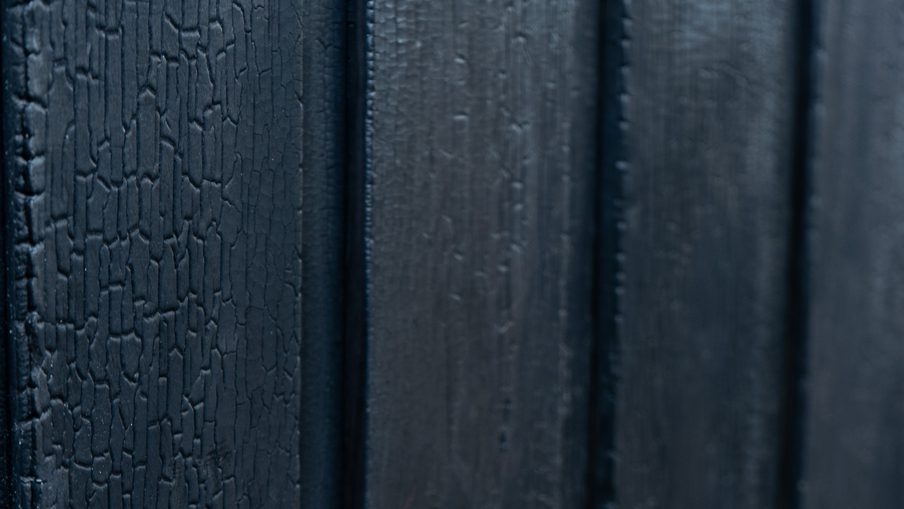
The practice of treating timber with fire, leaving behind a distinctive burned surface, dates back to 1700s Japan.
This traditional technique, with its striking and dramatic appearance, is making a modern comeback.
Charring timber is known as Yakisugi, represented by the Japanese kanji characters 焼杉, translating literally as ‘burned cedar’ or ‘charred cypress’.
Evidence suggests the technique became a popular technique in Japan as a way of weatherproof siding.

‘Sugi’ is a widespread type of Japanese cedar (Cryptomeria japonica), native to Japan and traditionally used for the process.
What happens when charring is that the flame converts the outer layer of wood fibres into carbon.
This carbonised layer seals the surface, closing up the wood’s pores so they absorb less moisture. The wood also becomes less attractive for insects and fungi.
This also imparts the deep black colour and, because the wood is already burned, makes the wood less susceptible to further fire damage.

Yakisugi was celebrated as a way to not only improve weather resistance of timber-clad structures, but also as a way to create a distinctive Japanese look.
It fell largely out of favour in the 20th century as more readily-available materials like plastic and cement became widespread.
But 21st-century designers have picked up and revived Yakisugi.

Why is charred wood so popular?
It is largely down to the unique, dramatic appearance. Charred timber, with its visual association with fire damage, has a real shock factor.
The colour is also mysterious, and the charcoal surface (with the timber’s grain still prominent) offers a bold, raw and clean look.
There are also varying degrees of charring. Light charring is slightly more tempered yet still eye-catching, whilst the highly-burned traditional finish gives an alligator skin texture.
It can be used for all types of wood projects: joinery, fencing, decking but, most popularly, cladding.
Charred wood also pairs effectively with design features, whether that’s simply a white wall or non-charred wood, making a clear visual statement.

Is charred cladding durable?
Despite the burned surface having a perceived fragility, the actual charred wood is genuinely highly durable.
When performed correctly, the charring process creates a carbon layer that slows further combustion and offers a degree of waterproof protection.
If a sustainably-sourced wood is chosen, the process is also completely natural, with no environmentally damaging chemicals involved.
That said, charred wood will still weather outdoors due to moisture and UV. To maintain the look and get the longest possible service, a transparent oil should be reapplied every few years.
A well-maintained charred cladding project can easily last several decades, with some good examples still performing after 50 years.

How is charred cladding made?
The charring is performed with a blowtorch, then finished with a brush, oil and a cloth.
All types of wood can be charred. However, open-celled, softwood timbers like cedar and pine – in keeping with Japanese tradition – are particularly suited.
They are lighter, more porous, which allows for a sufficient depth of char to be achieved. This prevents the burned effect being worn away over time, especially in exterior applications.
Wirebrushing and coating: a modern alternative to charred cladding
The uncompromising look of charred cladding can be achieved by coating, rather than having to actually char the wood.
This modern version of Yakisugi involves wirebrushing the timber’s surface to structure the grain and create texture, before applying a black stain.
It produces precisely the same arresting and eye-catching appearance as traditional Yakisugi charring, but with an even more robust and flake-resistant finish.
Chartex® is our cladding range for this high-performance, bold charred look.

View project: Thermo-ayous cladding in Chartex® black

View project: Western red cedar with black coated Thermo-pine cladding

View project: Black coated Thermo-pine garden room cladding
Like the look of charred cladding?
We stock a range of quality cladding, made from sustainably sourced timber and machined to profile at our site in North Yorkshire.
Factory coating systems we offer include Chartex®, created by wirebrushing and applying a black stain. Ideal for the charred look.


