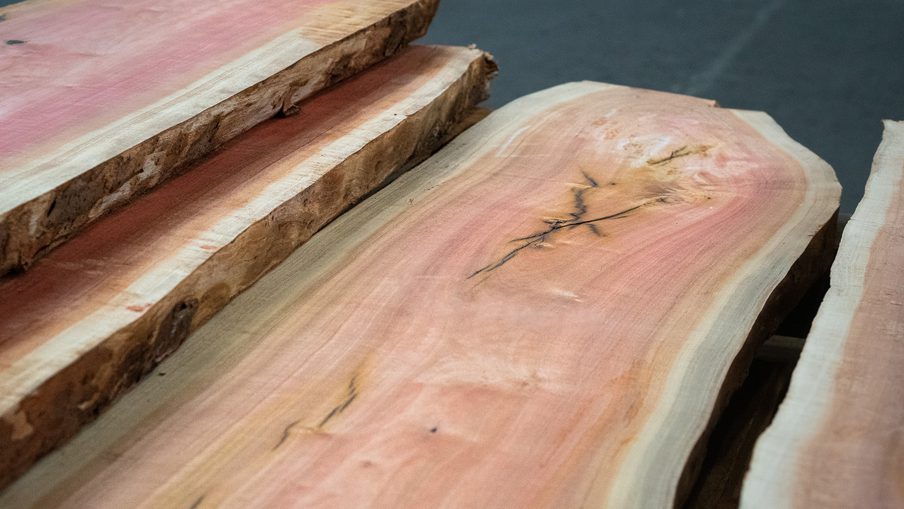
With its extraordinary mix of vivid warm pinks, pink ivory is a highly-coveted, one-of-a-kind exotic hardwood.
This eyecatching timber is native to Southern Africa, with populations across Zimbabwe, Mozambique, Botswana and South Africa.
Considered a ‘royal wood’ in historical times, pink ivory is similarly sacred today. South African populations are heavily protected, with only limited felling permits issued.
As a result, pink ivory is often referred to as ‘rarer than diamonds’ and cited as one of the most expensive commercial hardwoods.
But for a particularly special project or statement piece, could it be the timber of choice?
History
Pink ivory has a fascinating backstory, and was not-so-long-ago revered as a sacred royal tree.
During the 1800s, the Zulu Kingdom dominated Southern Africa and use of pink ivory was reserved exclusively for Zulu royals and chiefs. According to accounts, unauthorised possession by commoners was punished with the death penalty.
The tree served as a royal rite of passage for Zulu princes, who were required to find a wild pink ivory, craft a weapon from its wood and hunt a specific animal.
As a symbol of spiritual authority, the Zulu king would carry a pink ivory knobkerrie (a ceremonial walking stick) and the wood was used to make jewellery worn by the royal family.
The tree was also considered to have magical properties, with its berries eaten by wives of Zulu kings as a sedative.
Following the Anglo-Zulu War of 1879, there was a shift to commercial use. However, pink ivory is no less prized today.
Colour
Pink ivory has one of the most visually-arresting heartwoods in the natural world. Its vibrant warm pinks range from soft blush to a deep raspberry red.
The wood has a pale creamy brown sapwood, producing a remarkable contrast at the edges of the board – as you can see in these live edge slabs.

Depending on how a board is sawn, this transition from pink to brown can be gradual or bold. In some boards, the transition is abrupt, with a sharp, striking boundary between pink and cream.
The wood’s grain pattern is generally quite plain and calm, allowing the wood’s natural beauty to take centre stage.
Expect some occasional figuring, with fine, dark grain lines that add depth and visual interest.
Grain and texture
Pink ivory typically has a straight, slightly interlocking grain with a fine, even texture. It is very pleasing to the touch.
Physical properties
Pink ivory scores 14,370 N on the Janka hardness test, making it one of the world’s densest and strongest woods. For context, American white oak (itself considered a dense hardwood) clocks in around 6,000 N.
The timber is also exceptionally heavy and scratch resistant, with a dry weight of approximately 1,035 kg/m³. Again, for comparison, white oak weighs in at 755kg/m³.
This density gives pink ivory its coveted, glass-like lustre when properly worked.

Uses
Given its very high cost, pink ivory is generally only worked at a small scale, where its colour and grain can be fully appreciated.
It is often available as small blanks, used for knife handles, turned objects (like bowls or pens), jewellery boxes, jewellery itself or other decorative items.
Live edge slabs can be suitable for smaller-scale luxury furniture making, paneling or shelving. For larger decorative projects, using a veneer can allow the wood’s extraordinary colour to be harnessed more economically.
More niche applications include inlays in guitars, as well as for pool cues.
The wood is incredibly durable outdoors, but is prohibitively expensive for these applications.
Cost and prices
Pink ivory is amongst the world’s most expensive timbers. Its price reflects its prized nature and the fact the tree is protected with very limited supply.
Giving a precise figure on price is challenging. The timber is not sold in high volumes and costs can exceed most other exotic hardwoods.
Blanks, boards and slabs found in hobbyist shops are priced individually.
Small turning blanks can start around £15, whilst larger boards and slabs can run into several hundreds of pounds, depending on size and grade.
Wider, longer boards with a more vivid heartwood usually contribute to a higher price.

Sustainability
Pink ivory is not listed in the CITES Appendices or the IUCN Red List of Threatened Species.
However, the tree is protected in South Africa and can only be felled under limited permit. It is illegal for anyone to cut, damage, remove or sell the tree without authorisation.
Ensure your pink ivory is sourced legally from a responsible timber importer who purchases from sustainably-managed populations and can provide documentation of origin.
Planning a pink ivory project?
We occasionally take deliveries of this truly remarkable Southern African timber.
That’s in addition to a number of other eye-catching tropical African hardwoods, including zebrano, wenge and sapele.
You can visit our hobby hall in-person (near Ripon, North Yorkshire) and browse the full selection. It’s a timber lover’s paradise.
Alternatively, message our team and we’ll see how we can help make your next exotic timber project a reality.
Get in touch


