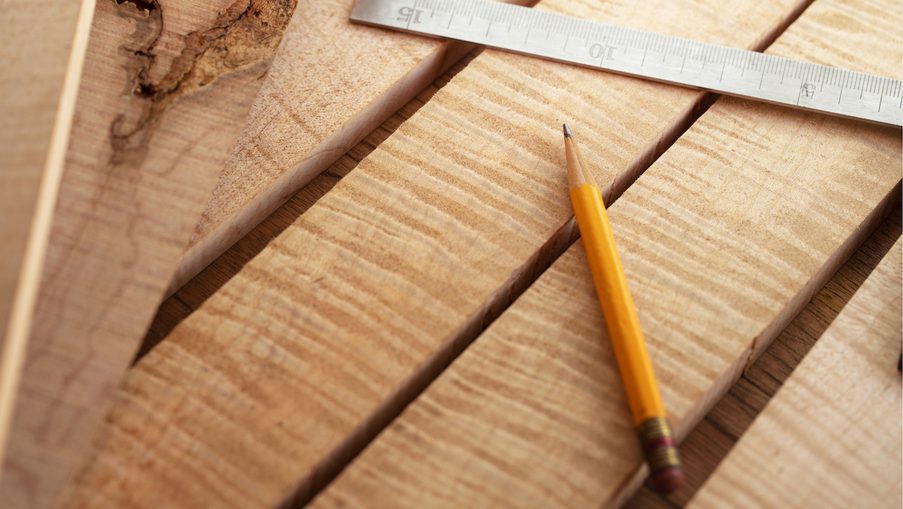
Wood grain refers to the arrangement of a wood’s fibres, formed during the growth of a tree.
When the tree is cut, these fibres reveal a natural pattern of relatively darker and lighter wood. This is commonly known as the grain, although the visual pattern is more accurately described as the wood’s ‘figure’.
The direction, size and arrangement of the fibres all affect the appearance of a piece of sawn timber. Grain can also influence the timber’s texture, strength, workability and finishing properties.
Perhaps its most attractive feature, grain is what gives wood much of its distinctive natural character, with each piece having a unique pattern.
With thousands of species of tree globally, there is no shortage of different figures and textures.
In this article...
Open vs closed grain: the role of pores
Hardwoods contain a type of longitudinal cell, called vessel cells. When the wood is cut, these vessels are exposed as pores, which have a significant impact on the appearance of sawn wood.
The size, number and distribution of these pores can vary hugely between different species. Some hardwoods have large, visible pores. Others have much smaller and evenly-distributed pores.
Pore size is a common way to describe hardwood grain patterns – they are often categorised as open-grained or closed-grained.
Open grain
Hardwoods with large, more visible pores are described as having an open grain. They are also called coarse-grained, although this refers more to texture than appearance.
An open grain is typical of ‘ring-porous’ trees that produce large vessels early in the growing season and smaller vessels later in the year. This contrast in cell size creates a stronger, more pronounced grain pattern.

One of the most striking open-grained woods is zebrano, an African hardwood. Its unusual, dramatic figure is created by bold streaks that vary from cream to dark chocolate.

Open grained woods usually have a coarser surface texture compared to closed-grain timbers.
Before finishing, these timbers are often treated with a grain filler to achieve a smoother, flatter surface.
Closed grain
Closed-grain hardwoods, also known as fine-grained or tight-grained, have much smaller and more evenly-distributed pores.
The lack of visible pores gives the wood a more subtle appearance. These timbers have a smoother, more uniform surface that does not generally require filling.


Some fine-grained timbers have almost no visible grain pattern at all, like beech and basswood.


Many woods show characteristics of both open and closed grain, making them harder to categorise. They are better classified as ‘semi-open-grained’ or ‘intermediate’. Examples fitting this description include black walnut and mahogany.

What about softwoods?
Unlike hardwoods, softwoods do not have vessel cells (and therefore do not have pores in the same way).
Softwood grain pattern is mainly created by the colour contrast between the earlywood (or springwood) and latewood (or summerwood), which are parts of wood in the tree’s growth rings.
Earlywood, formed early in the growing season, is usually lighter. Latewood is often darker and denser.
This difference in structure is why softwoods typically have simpler, more regular grain patterns than hardwoods.

However, softwoods can show plenty of character, especially when growth rings are pronounced. Also, softwoods can grow faster. This results in wider growth rings and visible grain.

Grain alignment
Wood grains can also be classified by the alignment of the fibres and the pattern this creates.
Open and closed grain describe the size and visibility of the pores, whilst alignment describes the direction in which the wood fibres run.
Common types of grain alignment include:
- Straight – the wood fibres run in a consistent, straight direction along the cut piece of timber. This type of grain is the most common and the easiest to work with.
- Spiral – the wood fibres twist around the trunk as the tree develops, rather than running vertically. This creates a sloped or twisted grain after cutting.
- Interlocked – the wood fibres change direction in alternating layers. This produces a ribbon-like, striped figure when quarter sawn. This can be decorative, but more difficult to work with.
- Irregular – the wood’s fibres run in unpredictable, varying directions. This can occur around knots, burrs or other areas where the tree’s growth was interrupted.
- Wavy – the fibers change direction in smooth waves, creating a more flowing visual look. This can produce a highly decorative timber, with figuring such as curly and fiddleback.

Woods with a straight grain are generally the easiest to work, providing reliable, consistent results. Those with an interlocking, irregular grain can be more prone to splitting, cracking and tearout (or ‘checking’).

Figuring
Unusual and decorative grain patterns are often described as figure or figuring. Highly-figured woods can add a decorative touch to any project.
Some figures are caused by normal growth, whilst others can be the result of stress, disease, branch junctions or other irregularities during the tree’s growth.
Some of the most popular examples include:
- Bird’s eye – commonly associated with maple, the figure appears as a series of small, rounded markings, giving the impression of bird-like eyes.
- Burr or burl — caused by a wart-like growth on a tree’s trunk or branch, often linked to injury or infection. This causes a highly irregular and twisted grain pattern.
- Crotch – a Y-shape pattern that occurs when a branch joins with the main trunk. It’s most commonly found in species of mahogany and walnut.
- Fiddleback, curly and flame – all describe variations of a wavy grain, where the fibres create a rippled or flame-like effect. This type of figure is highly sought after for musical instruments.
- Ribbon – often seen in quarter-sawn wood with an interlocked grain, this describes a kind of shimmering, slightly twisted ribbon appearance.
- Quilted – a wavy, rippling, bubble-like, pattern, giving a three-dimensional effect. Often associated with maple, sapele and mahogany.
- Silver – seen most clearly in quarter-sawn oak, where the cutting exposes the timber’s ray cells as pale flecks across the surface.
- Spalting – decorative dark lines, streaks or patches caused by fungal activity in the timber
- Tiger stripe – a bold striped figure created by colour variation or a wavy grain. In some timbers, dark streaking can be caused by fungal activity, often described as spalting.


Start your next timber project
At our Hobby Hall, we stock a wide range of sustainably-sourced imported sawn timber.
From the bold figure of zebrano to the smooth, subtle uniformity of white beech, we can help you find the right wood for your next project.
Contact us and we’ll be happy to help.
Get in touch


