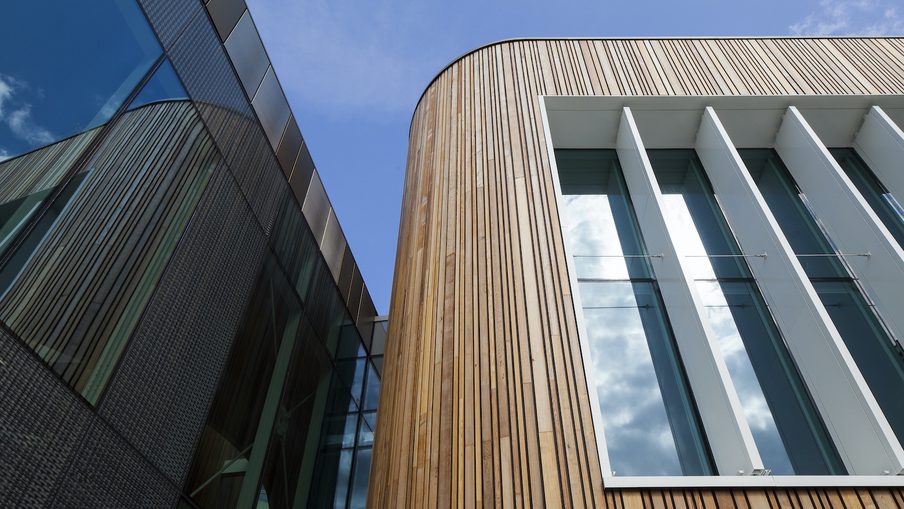
Western red cedar is one of the most popularly-specified timbers. It’s no surprise why.
With natural beauty, durability, stability and a signature sweet smell, this species is a time-honoured favourite for cladding, fencing, decking and any landscaping project.
Whether you’re planning a spot of home improvement or have a large-scale commercial project in mind, western red cedar is a wood that should be right near the top of your list.
Species introduction and facts
Known botanically as Thuja plicata, western red cedar takes its common name from the tree’s origins on the western coast of Canada and the United States. It is one of the most widespread trees in the Pacific Northwest, but has also been naturalised into Britain.
Also known as western redcedar, Pacific redcedar, giant cedar or simply cedar, the tree is a coniferous softwood with leaves that remain evergreen year round. The tree has a relatively fast growth rate — between 30 and 60cm per year.

When young, western red cedar trees have a cone-like shape. They typically grow between 20 and 35 metres in height (70–120 feet), but on the Pacific coast can reach heights of up to 60m (200 feet), with a trunk that’s 3–4m in diameter (9–13 feet).
Its small, scaly and pointed leaves come in opposite pairs and have white patches on the underside. A good way to identify a western red cedar tree is to crush one of these between your fingers – it will emit a distinctive, sweet pineapple or pear drop-like smell.
Despite its common name, this tree is not actually a ‘true’ cedar. This is because it comes from the Thuja rather than the Cedrus genus. It gets its common name from smelling and looking similar to actual cedars, like Cypriot cedar (Cedrus brevifolia), Deodar cedar (Cedrus deodara) and Lebanon cedar (Cedrus libani).

The tree is also symbolic. Some native tribes on the northwestern coast of North America refer to themselves as ‘people of the red cedar’. The tree was widely used for walls, roofs, totem poles, canoes, hand tools and much more.
The bark of the trees was also commonly used for clothing, mats and baskets. Thanks to cedar’s trademark durability, examples of this lifestyle still remain remarkably well preserved.
Properties
The species is renowned for its pleasing reddish-brown colour, straight grain, excellent workability, dimensional stability and remarkable natural durability. As such, it is a preferred choice for any project where weather resistance and attractiveness are key.
Appearance
- Colour: Displays a red to reddish-brown hue, with a mixture of reds, pinks and browns
- Grain: Clean, straight and even; relatively knot free
- Texture: Medium or rough texture
When it comes to attractiveness, cedar is considered to be amongst the elite, lending itself effortlessly and dynamically to a range of contemporary or traditional architectural designs and visions.


Expect a versatile warm reddish-brown colour, with perhaps the occasional salmon pink or chocolate brown streak. Of course, no two pieces of western red cedar are exactly the same, however!
Many designers regard western red cedar highly for its uniform straight, fine grain and relative knot-free appearance compared to many other popular timbers. Unless sanded, it typically has a medium texture.

Insect, moisture and decay resistance
The timber is valued for its astonishingly high levels of natural resistance to decay. Building codes across the world classify western red cedar as ‘durable’, enabling it to be used for exterior purposes without any treatment.
Slow growing and naturally durable compared to many other softwoods, the species contains thujaplicins, a type of chemical substance which acts as a natural fungicide. These extractives are toxic to decay-causing fungi, preventing the wood from rotting.
Thujaplicins are found in older western red cedar trees, not the saplings. They are substances which build up over time, meaning the outer part of the hardwood is often the most durable.
Remarkably, this fungicidal mechanism persists for over 100 years after the western red cedar tree is felled. This lends it well for use outdoors.


Stability
Because of its low density and shrinkage factor, western red cedar has superb dimensional stability. It is excellent at retaining its shape throughout its service life, particularly when applied externally – cedar products shrink and expand to a very minimal degree in response to changes in moisture.
Compared to other conifers, this species has twice the dimensional stability. It’s this resistance to warping, cupping and twisting that makes western red cedar such a prime species for exterior use.

Insulation
Western red cedar is one of the lightest softwoods available, with a unique structure. Its cells contain plenty of air space.
This makes it a natural thermal insulator with good temperature resistance, giving an element of protection to buildings it is applied to.
This open cell structure also makes it a very good sound insulator, able to absorb and dissipate sound. Ideal for any interior space where sound needs to be managed.
Hardness and scratch resistance
Because of its relative softness, western red cedar is a fairly sensitive wood that is more prone to dents and scratches. On the Janka scale, the species has a hardness of 350 lbf; white oak, for comparison, has 1,360 lbf.
For high-impact, high-traffic surfaces, such as a busy garden deck or flooring, another species might be a better bet.
Workability, gluing and finishing
Lightweight and non-resinous, western red cedar is easy to work with and simple to finish. A lack of pitch and resin also allows it to take glue bonds from a wide range of adhesives exceptionally well.
When nailing any cedar, be sure to use stainless steel. Iron fixings will react with the water-soluble polyphenols that naturally occur in the species, causing a rather unsightly blue-black blotting and staining over time.
Grades
Western red cedar is available in a number of grades, from knotty to knot-free.
The most popular commercially available grade is No.2 Clear & Better; this allows for only a small amount of knots, which are always tight and sound.
Lower grades are usually less durable and will contain more sapwood.

Uses
With exceptional dimensional stability, natural resistance to the elements, uniform grain and a gorgeous reddish-brown colour, western red cedar is the ideal timber for a range of stylish, design-led outdoor projects. This can include:
- Cladding
- Fencing
- Decking
- Garden features
- Garden furniture
- Panelling
- Fascia
Whilst it doesn’t quite have the loading capacity of some other types of timber, western red cedar can still be used structurally, particularly outdoors.
Western red cedar has a distinctive aromatic quality, and some substances in the oil from its leaves can also be used as an ingredient for cosmetics purposes and perfumery. Other niche uses include guitar soundboards and beehive components.
Because of its abundance on the coasts of North America, the timber was historically very popular amongst indigenous societies for housing, clothing, canoes, instruments, totem poles, masks and much more.
Is western red cedar sustainable?
Western red cedar comes from some of the world’s most sustainably-managed forests. According to the IUCN, it is a ‘species of least concern’ with a stable population trend.
The wood is also not listed in the CITES appendices of endangered animals and plants.
The species is also lightweight, meaning it’s less fuel intensive to transport, as well as scoring low for water and air pollution.

Finishes, treatments, maintenance & restoration of western red cedar
When it comes to outdoor use, western red cedar is part of an exclusive club of timbers: it doesn’t strictly require any treatment.
However, over time, untreated cedar that is exposed to the sun’s UV will slowly weather to a silvery-grey. Additionally, despite its impeccable durability, Western Red Cedar can still benefit from a protective treatment for maximum longevity.
Fortunately, this species is very accepting of different treatments and finishes. Popular options include solid colour paints, semi-transparent stains and transparent preservatives.
Read more: finishes and maintenance guide for western red cedar

How much does western red cedar cost per metre?
Prices can fluctuate. As of mid-2026, western red cedar cladding in a V-groove profile comes in at around £60 + VAT per square metre.
This slightly higher price point reflects western red cedar’s status as a sought-after, premium, high-performance exterior timber — many design-led homeowners, self-builders and architects still find this to be a very fair price worth paying for their project.
For those seeking a cost saving, Alaskan Yellow Cedar treated with a honey-tinted stain can very closely mimick Western Red Cedar. We've even written a guide to Western Red Cedar alternatives.
Start your western red cedar project today
Looking to get your hands on some of this delightful timber? We’re a leading UK timber importer, supplier and machining specialist of over 60 years.
Take a look at our stocks of western red cedar sawn timber, cladding and fencing and get in touch with our team today using the button below.
Contact us


