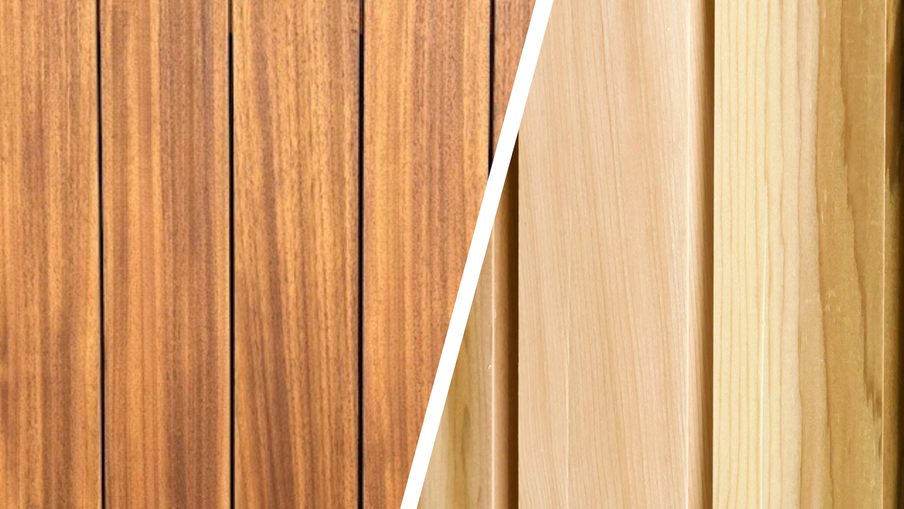
Thermo-ayous and western red cedar are both high-performance exterior timbers.
The biggest difference between them relates to their appearance. Thermo-ayous is a clear-grade product with a medium brown colour, whilst western red cedar offers a classic, characterful mix of reds, pinks and medium browns.
Thermo-ayous is also marginally more cost effective than western red cedar, typically coming in around 10-15% cheaper.
But whether you’re planning a cladding or fencing project, both ayous and cedar represent superb choices due to their natural outdoor durability and stability.
Appearance
Thermo-ayous is a heat-modified wood product. After baking, the African hardwood takes on a pleasing, tropical medium brown colour. The wood is knot-free, offering a clean, contemporary, uniform look.


View project: Thermo-ayous square-edged vertical cladding
Western red cedar is renowned for its eye-catching natural mix of reds, browns and even salmon pinks. Most boards are clear grade, but sometimes there can be occasional smaller knots. However, it’s perfectly possible to specify a clear-grade product.


View project: Western red cedar horizontal cladding
Performance
There’s little to separate these woods when it comes to outdoor durability and dimensional stability.
Thermo-ayous, for its part, is highly resistant to water and fungi. The heat modification process, which consists of drying, heating and cooling, produces changes in the cellular composition of the wood.
This breaks down hemicellulose, a sugar that decay-causing organisms would otherwise feed on. The process also changes the sites that bond with water molecules, meaning the wood absorbs less moisture.
Thermo-ayous achieves a Class 1 or 2 durability rating (‘Very Durable’ or ‘Durable’) according to EU standards, with a possible service life of over 50 years.
Western red cedar is naturally durable and stable. It contains thujaplicins, a type of chemical substance that acts as a natural fungicide.
Not only are these natural extractives toxic to decay-causing fungi, but they help cedar to resist moisture absorption, giving the wood a long outdoor service life.
The species is typically classified as ‘Durable’ (Class 2) by most building codes, meaning it can be left untreated when used externally.
However, many choose to apply a transparent preservative or semi-transparent stain to enhance the cedar’s water and UV resistance. The wood has excellent finish retention qualities.
Cost
Western red cedar typically commands a 10-15% premium compared to Thermo-ayous.
In a vertical shadow gap cladding profile, Thermo-ayous is £57.70 + VAT per m², compared to £67.30 + VAT per m² for western red cedar.
18mm x 45mm fencing slats cost £45.45 + VAT per m² in Thermo-ayous, compared to £50 + VAT per m² in western red cedar. These prices are correct as of January 2026.
This price discrepancy is purely down to demand and does not reflect the quality or longevity of either product. Western red cedar is a widely-recognised, undeniably stunning all-time classic, whilst Thermo-ayous is relatively new to the market and still gaining traction.
Start your project today
Whether you prefer the sleek, uniform appearance of Thermo-ayous or the classic, characterful pinks and browns of western red cedar, we’re here to help bring your project to life.
Explore our range of Thermo-ayous cladding, Thermo-ayous fencing, western red cedar cladding and western red cedar fencing.
Contact us


